東漢 (25-220) 綠釉陶鍾
Pottery jar with green glaze, Eastern Han dynasty 25-220C.E.
清宮少見的出土陶器
這件陶鍾造形仿自青銅器,綠釉表面因水分滲侵,局部泛現七彩銀斑,器形、釉色與裝飾特徵皆展現出東漢樣式。由腹身外壁所刻乾隆皇帝御製詩文,可知此器出土於乾隆二十四年(1759)之前,而後輾轉流進清宮成為皇室典藏。這樣的綠釉是不是也接近青銅器的鏽色呢?歡迎您觀賞過青銅器後,再回來比較看看。
五代 (907-960) 越窯 秘色青瓷洗
Celadon water container, Yue Ware, Five dynasty 907-960 C.E.
傳說中的秘色瓷
這件越窯秘色青瓷洗,釉質與器形近似五代墓葬出土品,或可視為五代上層階級使用之佳器。器內墨書「汝窯撇口果洗一件」,可知這件作品曾被清室善後委員會點查人員認為是汝窯瓷器。請與205陳列室內的幾件汝窯作品比較一下,感受這兩種青瓷釉料質感的差異吧。
北宋 十一世紀後半至十二世紀早期 汝窯 青瓷紙槌瓶 「奉華」銘
Feng-hua mallet vase with bluish-blue glaze, Ru ware, Northern Song dynasty Late 11th-early 12th century
宋徽宗的汝窯器
薄胎上滿施淡灰藍色釉,釉多腴潤。薄釉處可見香灰色胎,釉表在光線照射下呈淡粉紅色,並密佈淺黃色細紋。紙槌瓶的原形可追溯到中西亞及北非玻璃工藝。全世界共有兩件完整的汝窯青瓷紙槌瓶傳世,皆典藏於本院。您可以比較展覽中的耀州窯、南宋官窯及龍泉窯青瓷,汝窯青瓷典雅的釉色是不是顯得獨樹一格呢?- Potted thinly, the vases are entirely enveloped in a light grayish-blue glaze that is thick and lustrous. Where the glaze is thinner, the grayish biscuit underneath can be seen. A mysterious, light pink color emanates from within the translucent layer of glaze. A hint of yellow crackle (原文為"glazing") also covers the surface of the vase. The form of the mallet-shaped Ru ware vases is thought to be derived from Iranian and Egyptian glass wares popular between the 9th and 12th centuries.
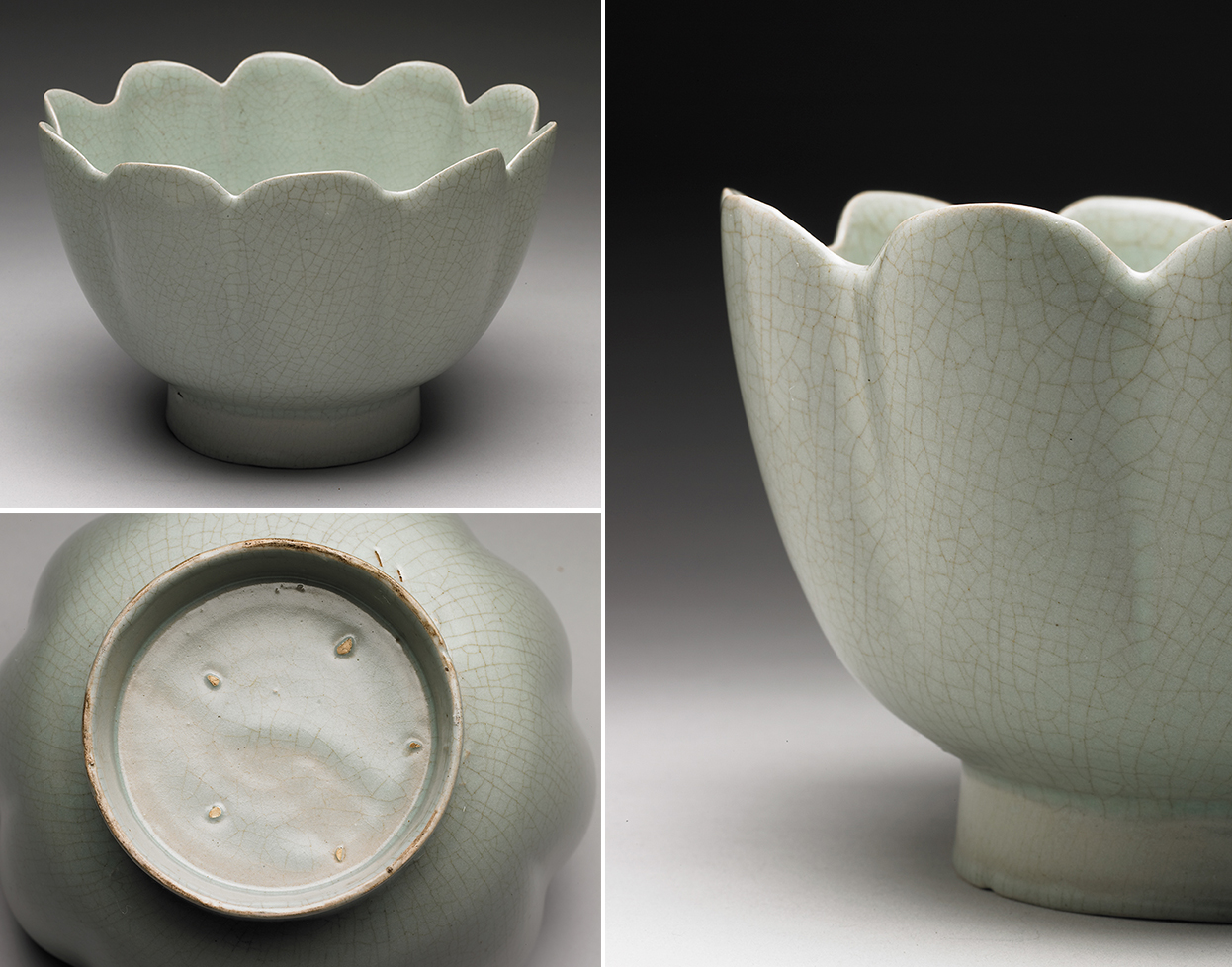
北宋 十一世紀後至十二世紀早期 汝窯 青瓷蓮花式溫碗
Lotus-shaped warming bowl in light bluish-green glaze, Ru ware, Late 11th-early 12th century
傳世唯一的汝窯溫碗
器形仿自金銀器,全器滿釉,僅於底部留有五枚芝麻點狀的支燒痕跡。青釉釉質勻潤,器表滿佈細密開片紋,整體氣質靜謐典雅。北宋汝窯擁有「青瓷之魁」的美譽,這件作品更是汝窯同型器中舉世唯一的傳世品。請細細品味汝窯青瓷釉色與開片細紋渾然天成的雅緻氣質吧。
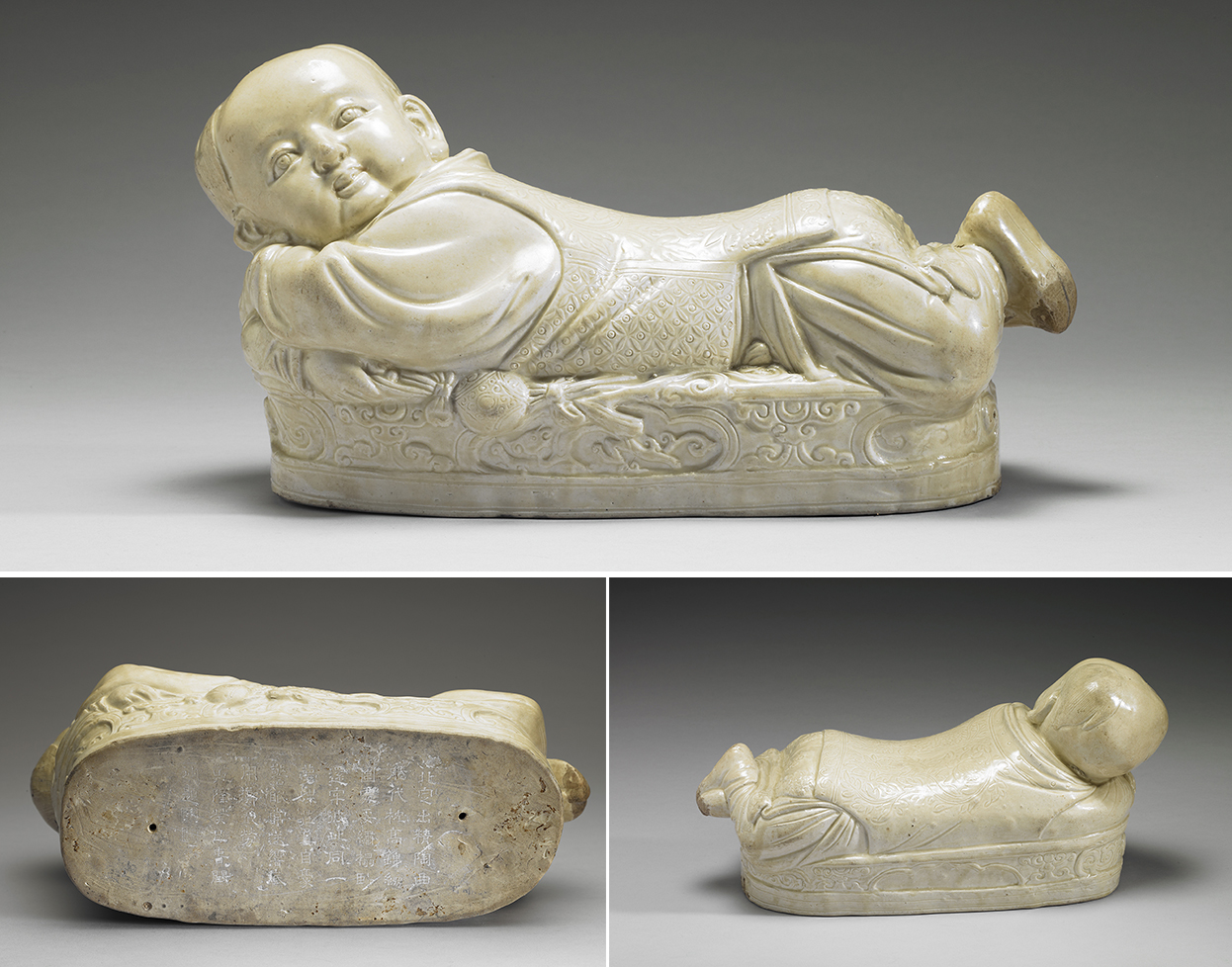
北宋 十二世紀 定窯 白瓷嬰兒枕
Pillow in the shape of recumbent child, Ding ware, Northern Song dynasty 12th century
最美的嬰兒枕
北宋定窯白瓷嬰兒枕作嬰孩型態,背部即為頭枕之處,設計甚具巧思。類似的嬰兒枕全世界目前所知僅有三件,本件的釉色之美及裝飾之精為其中之最,兼之流傳有序,稱其為國之瑰寶可說實至名歸。男嬰身著長衫長褲,外罩錦緞背心,您可以仔細欣賞他衣著上的各種紋飾,例如長袍下裳印了圓形朵花,背心前襟印了球形錦紋,後背則刻劃了纏枝牡丹,是不是非常精巧可愛呢?
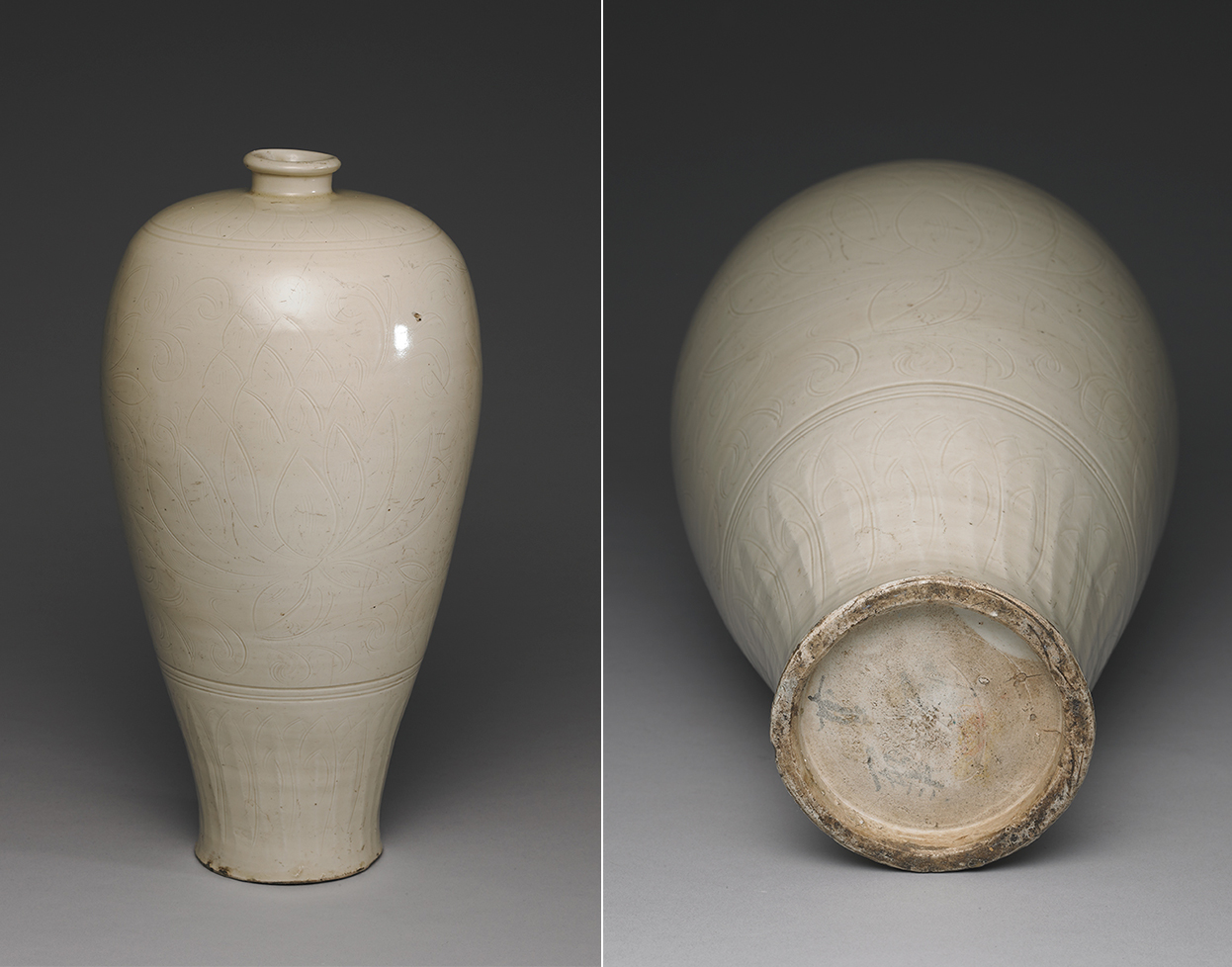
北宋 十一至十二世紀 定窯 白瓷劃花蓮紋梅瓶
Meiping vase with incised lotus decoration, Ding ware, Northern Song dynasty 11th-12th century
宋朝人的酒器
此種小口、短頸、豐肩,器腹以下漸次收斂的器形,稱為梅瓶。「梅瓶」一詞,在宋朝蘇東坡的詩中,已經開始使用。透過多件梅瓶帶有與「酒」相關銘款的線索,而可推知宋朝梅瓶應作為酒器使用。請試著想像,宋朝人從梅瓶倒出美酒,宴樂飲酒的畫面吧!Wine Vessel of the Song Dynasty
This vessel type of small opening, short neck, round shoulder and with the body gradually narrowing down from its belly is named "meiping". The term "meiping" was seen in a poem of Su Dongpo in the Song dynasty. Through the clues given from inscriptions related to "wine" on many meiping pieces, it is known that meiping was used as wine vessel in the Song dynasty.
Please imagine the way how Song people poured out fine wine from a meiping vase and enjoyed the festivity.
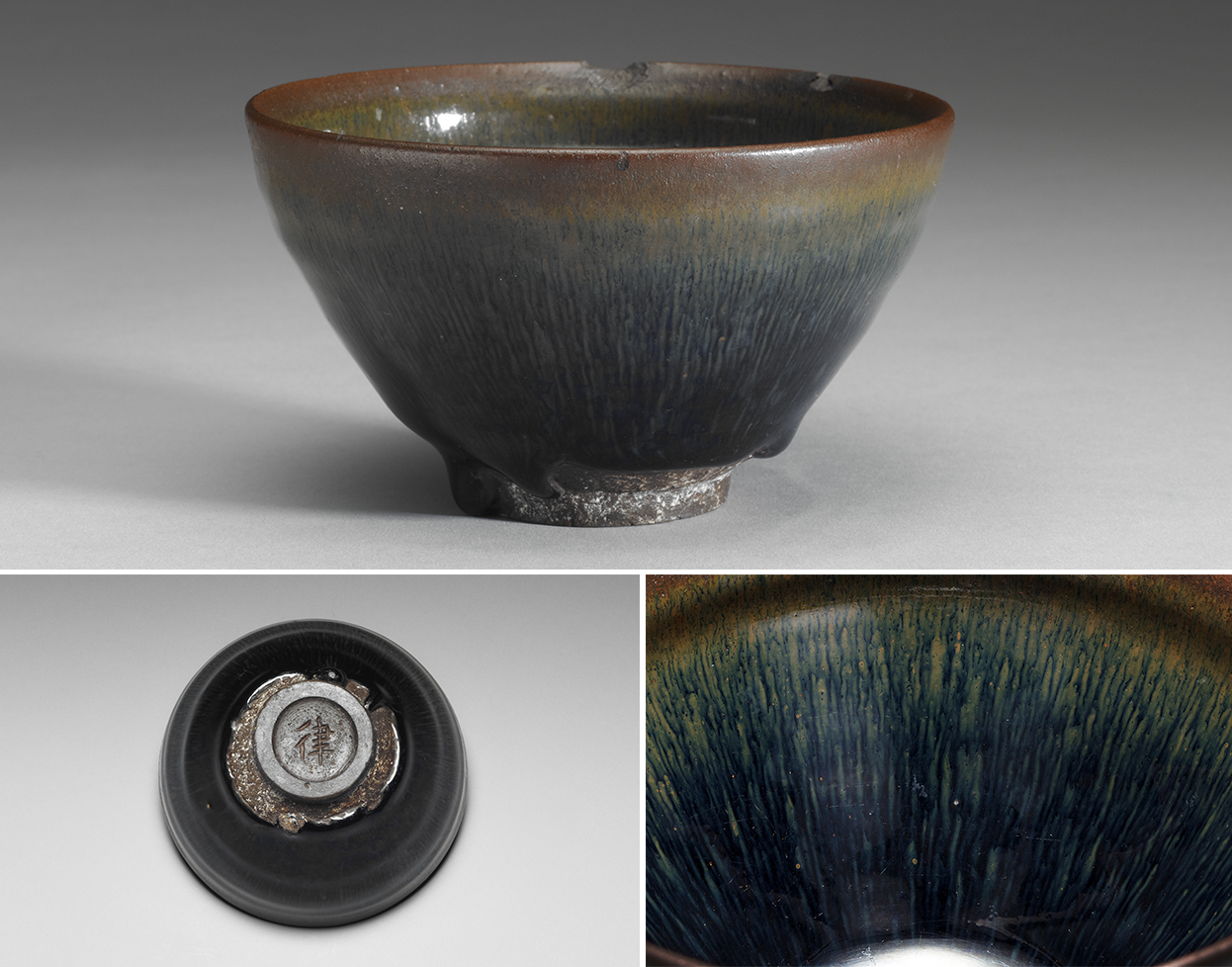
宋 十一至十三世紀 建窯 黑釉兔毫盞
Bowl with "hare's fur" striations on a black ground, Jian ware, Song dynasty 11th-13th century
鬥茶的利器
釉面光亮得像漆一般!一絲一絲黃色條縷絲紋,跟野兔身上的毫毛相似,因此有了「兔毫盞」的稱呼。宋代文人之間盛行點茶、鬥茶的活動,為了襯托熱水點茶的白色茶沫,以及便於分辨水痕,厚胎易於保溫的建窯黑釉盞,便成為當時流行的品類。請想像一下,宋朝人一邊喝茶,一邊欣賞兔毫紋的場景吧!Article for the Tea Match
The surface of the glaze is as glossy as lacquer! And the yellow striations, which resemble the fur of a wild hare, accounting for the name: "hare-fur tea bowls". The activity of "whisk tea" and have the "tea match" was popular among literati in the Song dynasty. The white froth produced from the hot water used to brew tea created a striking visual juxtaposition with the black glaze. The heat retaining substantial clay bodies of black glazed Jian ware tea bowls, such as this piece, were fashionable in the period.
Please have a thought about how Song people drinking tea while appreciating the "hare-fur tea bowls".
北宋 十至十二世紀 耀州窯 青瓷印花菊花紋碗
Bowl with impressed chrysanthemum decoration in yellowish-green glaze, Yaozhou ware, Northern Song dynasty 10th-12th century
印花與劃花之美
耀州窯的作品以帶橄欖綠色調、外表瑩亮的青釉聞名,且常以印花、劃花呈現豐富紋樣。像是這件碗,內底心模印團菊花紋一朵,器內周壁則印纏枝菊花;碗外壁劃刻菊花瓣,自器底至口沿作放射狀排列,紋路流暢嫻熟。大家可以觀察看看,器內模印與器外劃花裝飾的差異。- The kiln of Yaozhou wares produced celadon wares famed for their lustrous olive green glazes, and frequently impressed and carved with rich decoration. For example, the center of this bowl's interior is impressed with a single circular chrysanthemum flower, while the surrounding walls are decorated with scrolling branches of chrysanthemum. The exterior sides of the bowl are carved with chrysanthemum petals, freely and deftly executed in a radiating pattern that encircles the bowl from rim to base.
南宋 十二至十三世紀 官窯 青瓷貫耳壺
Hu vessel with light bluish-green glaze, Guan ware, Southern Song dynasty 12th-13th century
最大的南宋官窯瓷器
這件作品仿自青銅貫耳壺,器形端整碩大,可以說是傳世所見最大件的南宋官窯瓷器。器身通體施罩青釉,釉質瑩潤,色呈粉青,內外釉表帶有淡色開片紋。仔細觀察口沿釉薄處及足底無釉處,可見到深色的胎骨,為南宋官窯的典型特色。您可以觀察一下展覽中的南宋官窯瓷器,它們的開片紋是不是各有特色呢?- This piece emulates a bronze cylinder handled Hu wine vessel. This imposing and formally modeled piece is the largest extant heirloom piece of Southern Song Guan ware. The entire of this Hu vessel is glazed bluish-green. The surface of the light bluish-green lustrous glaze is suffused with a faint crackle design. Where the glaze is thin on the rim and the unglazed border of the foot reveals the dark ochre of the underlying clay, displaying the archetypal qualities of Southern Song Guan ware.
南宋 十三世紀 龍泉窯 青瓷鳳耳瓶
Vase with phoenix-shaped handles in celadon glaze, Longquan ware, Southern Song dynasty 13th century
紙槌瓶的變形
這件青瓷瓶,頸部兩側貼飾鳳形耳,器形端整大方,是南宋時期龍泉窯的代表作之一。南宋之後,龍泉窯成為供應中國海內外器用的重要窯場,不僅在許多宋、元時期的墓葬及窖藏中頻繁出現,在海外的貿易遺址也經常可見其蹤跡。請試著與汝窯紙槌瓶比較,加上了鳳耳的龍泉窯瓶,是不是也有另一種趣味呢?- This celadon vase, either side of long neck features a phoenix shaped handle. This imposing and regularly shaped vessel is exemplary of Southern Song Longquan ware. After the Southern Song dynasty, the Longquan kilns became an important supplier of wares for China both domestically and internationally. Not only were many of these wares found in Song and Yuan period tombs and hoards, sherds of Longquan ware have also frequently been found at internationally significant trading sites.
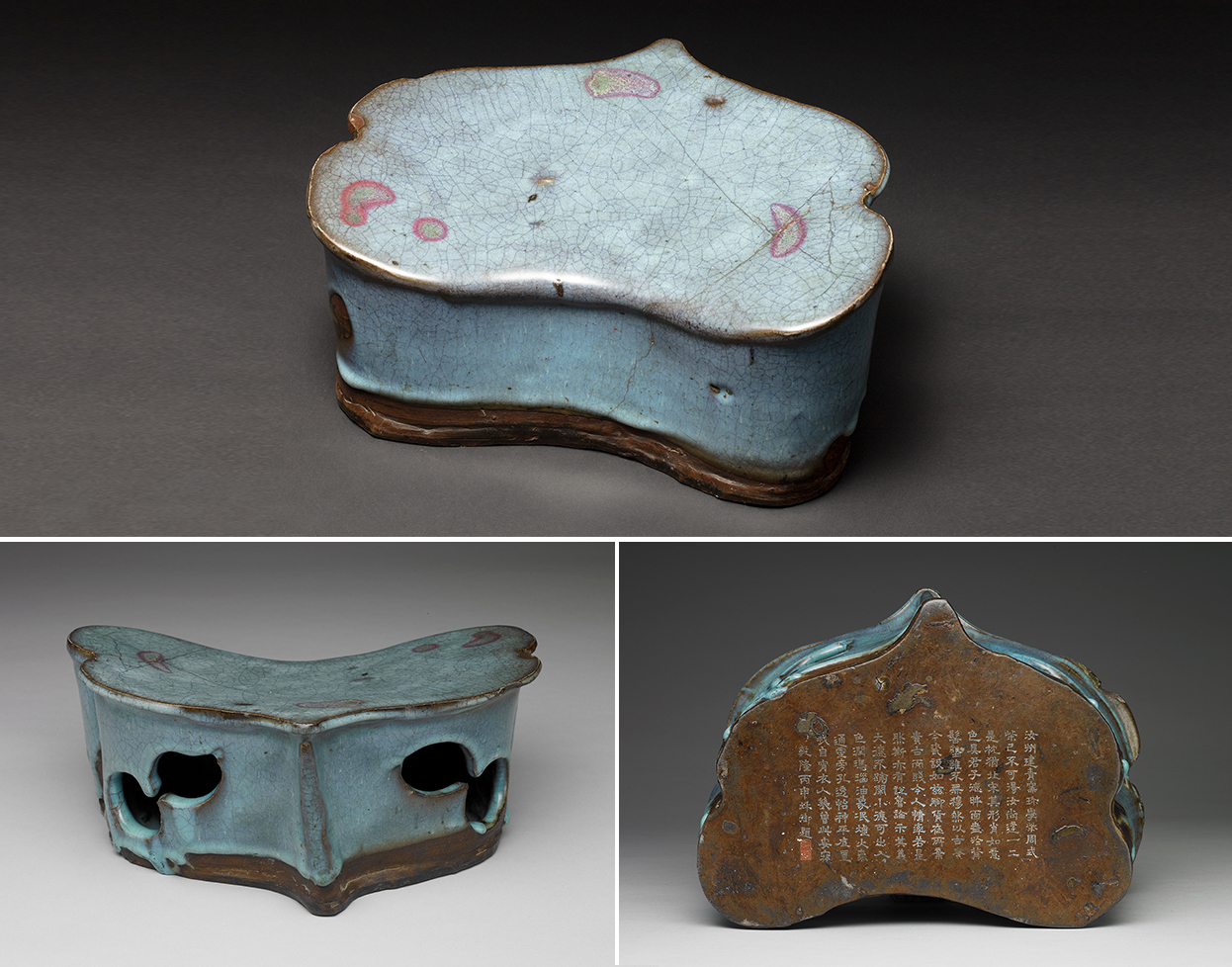
金至元 十二至十三世紀 鈞窯 天青釉紫斑如意枕
Ruyi-shaped pillow with sky blue glaze and purple spots, Jun ware, Jin to Yuan dynasty 12th-13th century
枕頭上的斑斕
這件枕形似如意,中心略凹,週壁前高後低,兩側各開有葫蘆形孔。胎骨堅厚,施罩天藍色乳濁青釉,釉表有細紋開片,外壁有明顯的橘皮棕眼痕,釉表兼飾有銅紅元素紫紅色彩斑,在天青底釉襯托下,紋樣渾然天成。這些紫紅色的彩斑,屬於「窯變」的一種,我們可以從中感受到摶泥幻化的神奇之處。- This pillow has an idealized auspicious shaped (ruyi ). It is concave at the center, with a high wall at the front and a low wall the rear. There are gourd shaped openings on two sides. The substantial clay body is coated with a milky sky-blue glaze, the surface of which shows a slight crackle. The exterior wall is clearly marked with small orange brown ovals. The surface of the glaze features reddish-purple dots produced by copper red pigments, which act as the perfect complement to the sky-blue base color of the glaze.
元 十四世紀 卵白釉印花番蓮紋碗 內壁印「樞府」款
Bowl with impressed floral decoration and shu fu mark, Yuan dynasty 14th century
元朝出現的新釉色
除圈足外全器施罩卵白釉,釉汁平勻、胎膩而細。卵白釉在元代景德鎮新燒完成,色調偏青,具失透性而不甚流動,釉厚無開片。器內底與內壁帶繁複齊整的印花花卉紋,內壁花間一側印陽文楷書「樞」字,對側為「府」字。請與展覽中的宋代定窯白瓷及明代永樂甜白瓷相比,試著區別不同白瓷釉色的差異吧。
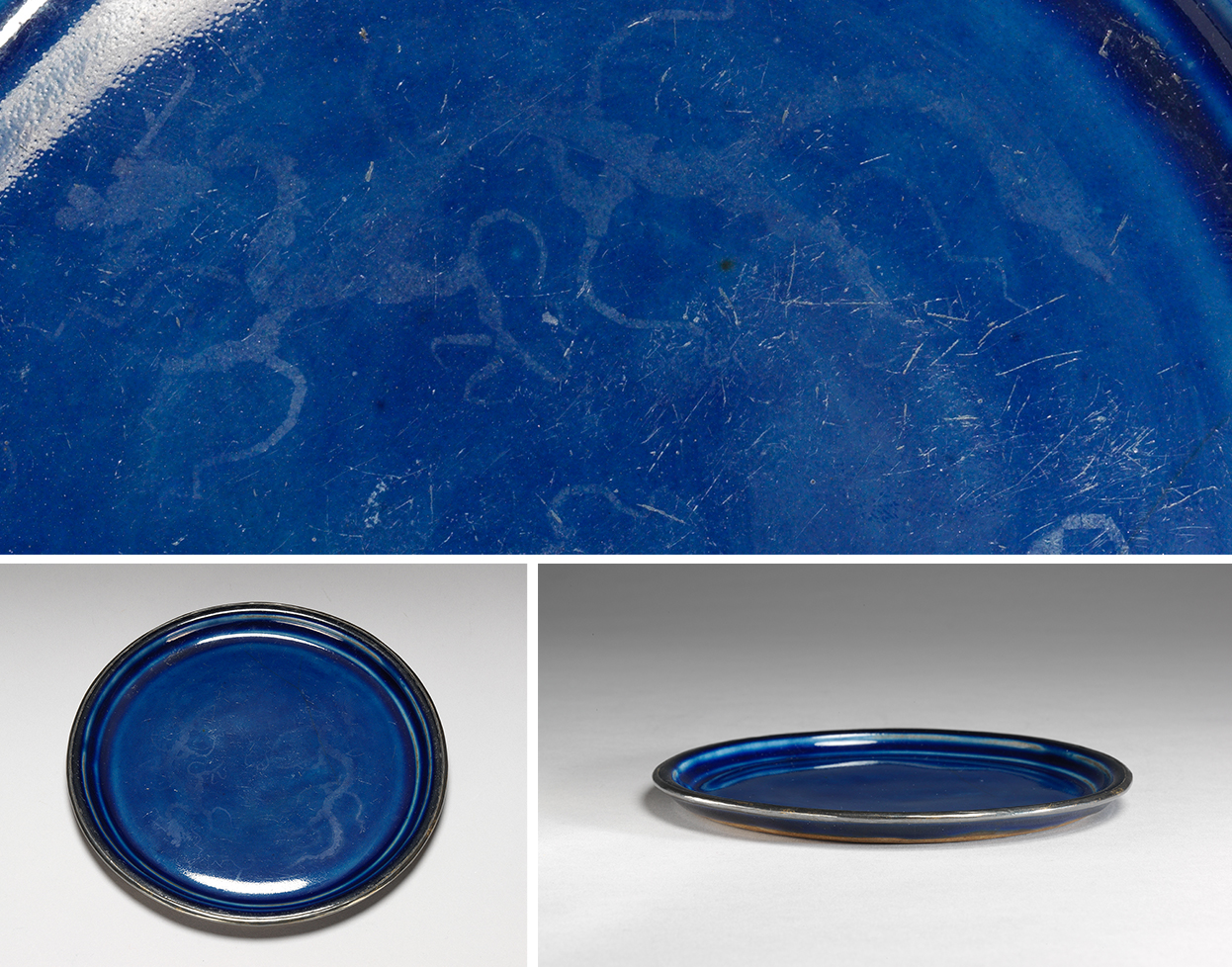
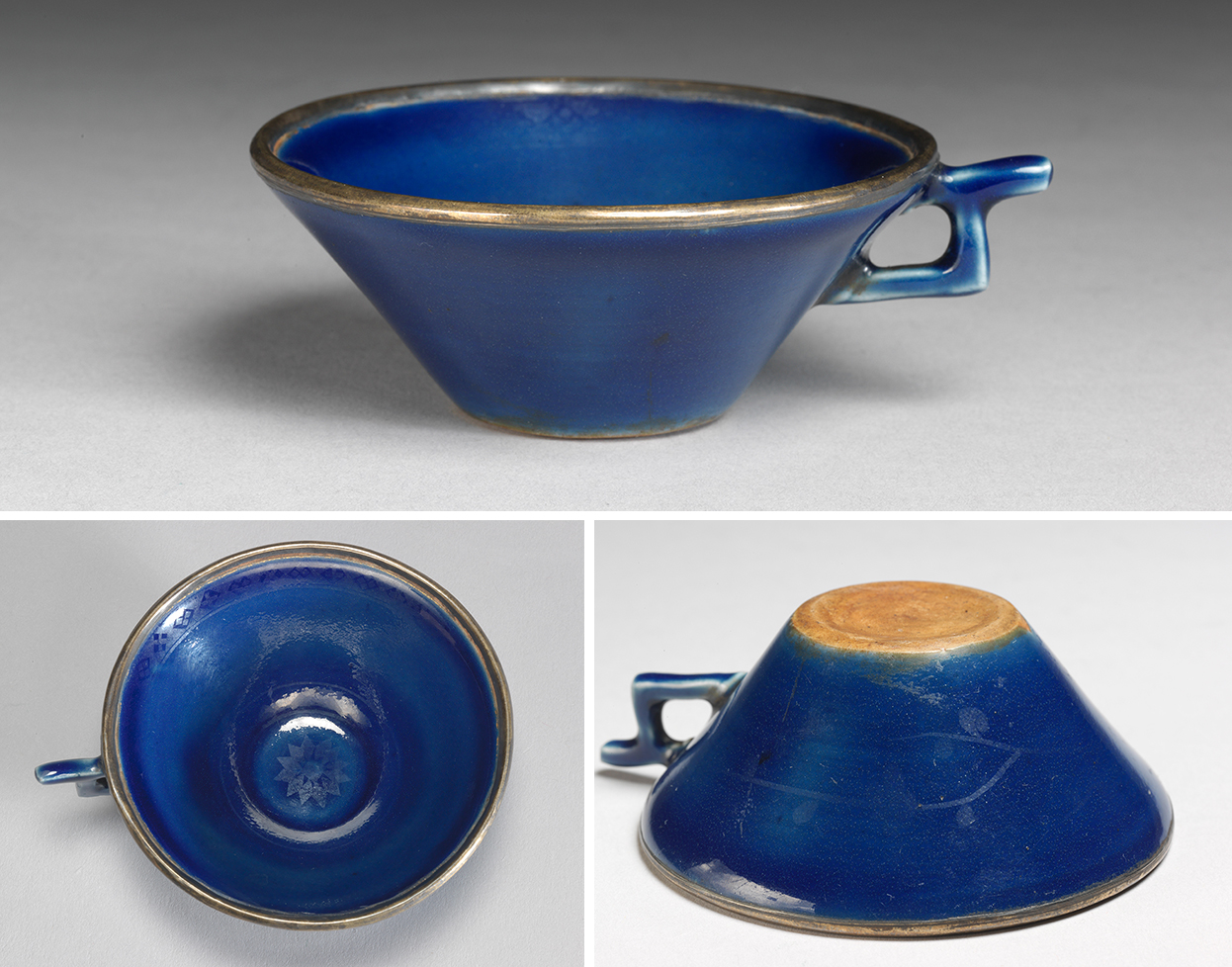
元 (1271-1368) 霽青盤,單把杯
Dish with cobalt blue glaze plate & Single-handled cup with cobalt blue glaze, Yuan dynasty, 1271-1368
消失的金彩
全器施罩富含氧化鈷的霽青釉,高溫燒成後色澤靛青幽謐如藍寶石,為元代的新興產品,存世數量極少。盤內釉表原有金彩,現已脫落,但隱約仍可見雙龍與火珠紋的痕跡。杯子的內口沿與內底則可隱約看見菱格紋、幾何十二星芒團花紋。此類單把小杯盞與折沿盤並陳出土的情形,也見於元代其它瓷窯產品中,說明此種盤、盞成套組合的酒器是元人慣用的形式。請試著想像這件作品剛完成時,金彩裝飾必定帶來相當華麗耀眼的效果吧。
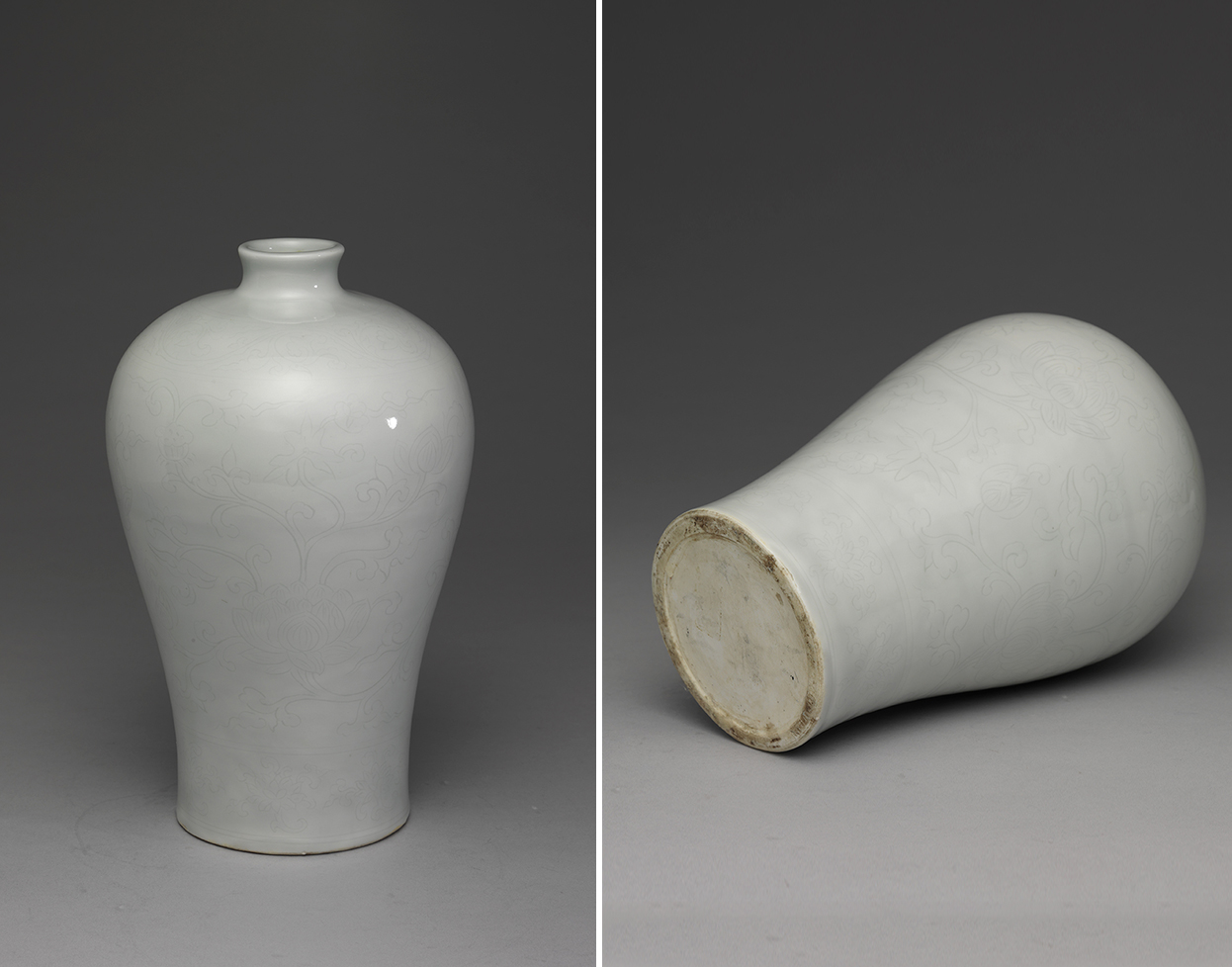
明 永樂 (1403-1424) 甜白蓮花紋梅瓶
Meiping vase with incised decoration of lotus flower in sweet white glaze, Ming dynasty, Yongle reign, 1403-1424
白砂糖般的釉色
這件梅瓶全器施甜白釉,釉質瑩白潤澤。近代學者考證日常食用之白砂糖於晚明問世,所以晚明鑑賞、收藏家們即以當時白糖的「甜」來形容溫潤的永樂白瓷器,此一用法亦沿用至今。您看到刻劃在瓶身甜白釉上的紋飾了嗎? 尤其是器腹部上或綻放或含苞的纏枝蓮花紋,值得您細細品味。
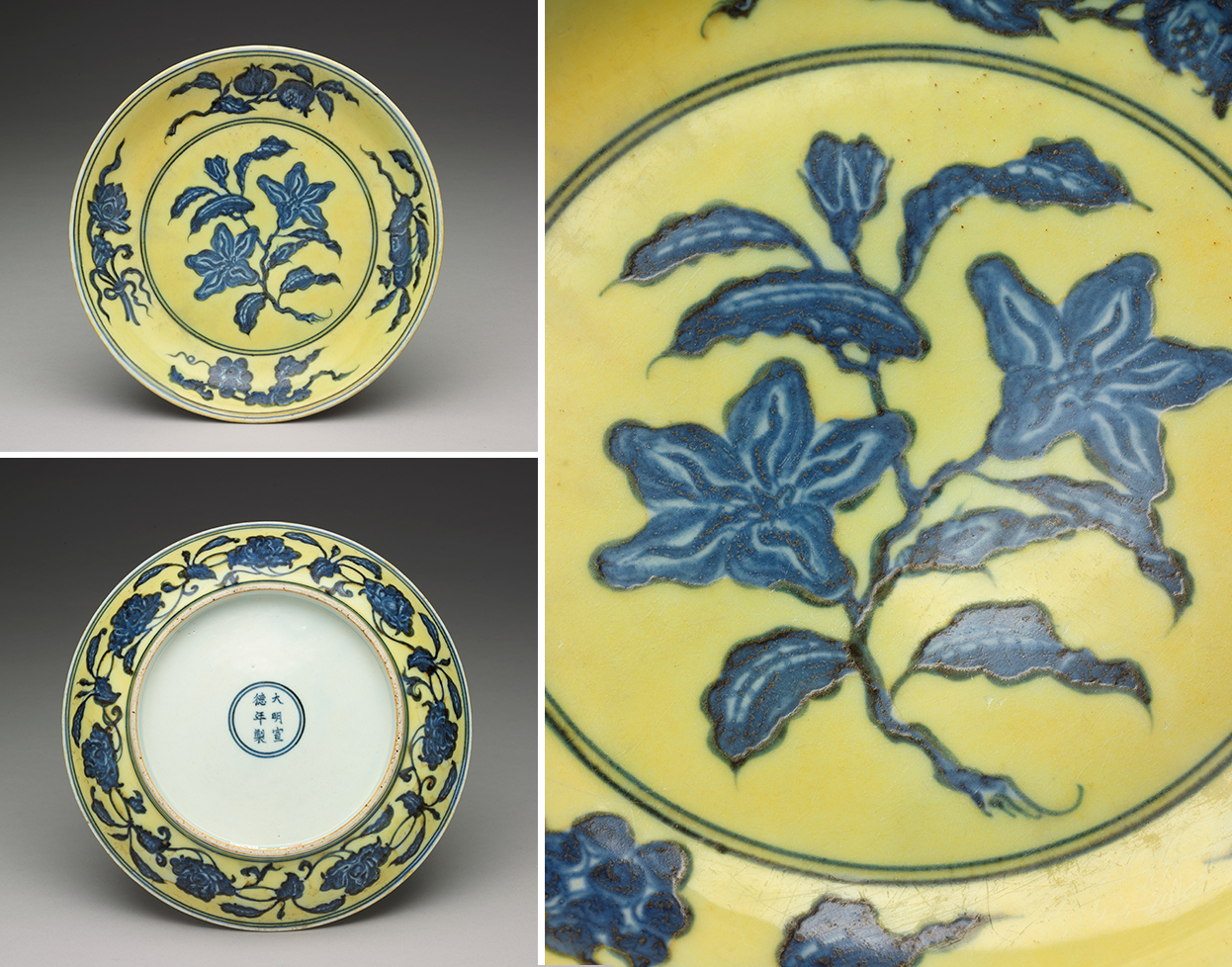
明 宣德 (1426-1435) 青花黃彩梔子花果紋盤
Dish with gardenia, fruits and floral scrolls in underglaze blue, Ming dynasty, Xuande reign, 1426-1435
青花與黃彩的相遇
青花黃彩器的裝飾技法始於明朝宣德時期。如這件盤的裝飾順序,是先以青花鈷料描繪內底的折枝梔子花,內壁的石榴、柿子、葡萄、蓮實四種瑞果,以及外壁的七朵轉枝芍藥,高溫燒製後,再於空白處填上黃釉,經二次低溫燒成。大家可以仔細觀察,有沒有青花被黃釉覆蓋,或是黃釉沒有填滿的地方。- Underglaze blue and overglaze yellow decoration were first developed in the Xuande period of the Ming dynasty. This vessel's decoration was made through the following process. First, blue cobalt pigment was used to paint the sprays of gardenia at the base of the interior, the auspicious pomegranate, persimmon, grape and lotus pods in the interior wall, and the seven scrolling Chinese peonies on the exterior wall. The vessel was then fired at a high temperature, after which the exposed white areas were painted with yellow glaze, and the vessel was fired again at a lower temperature.
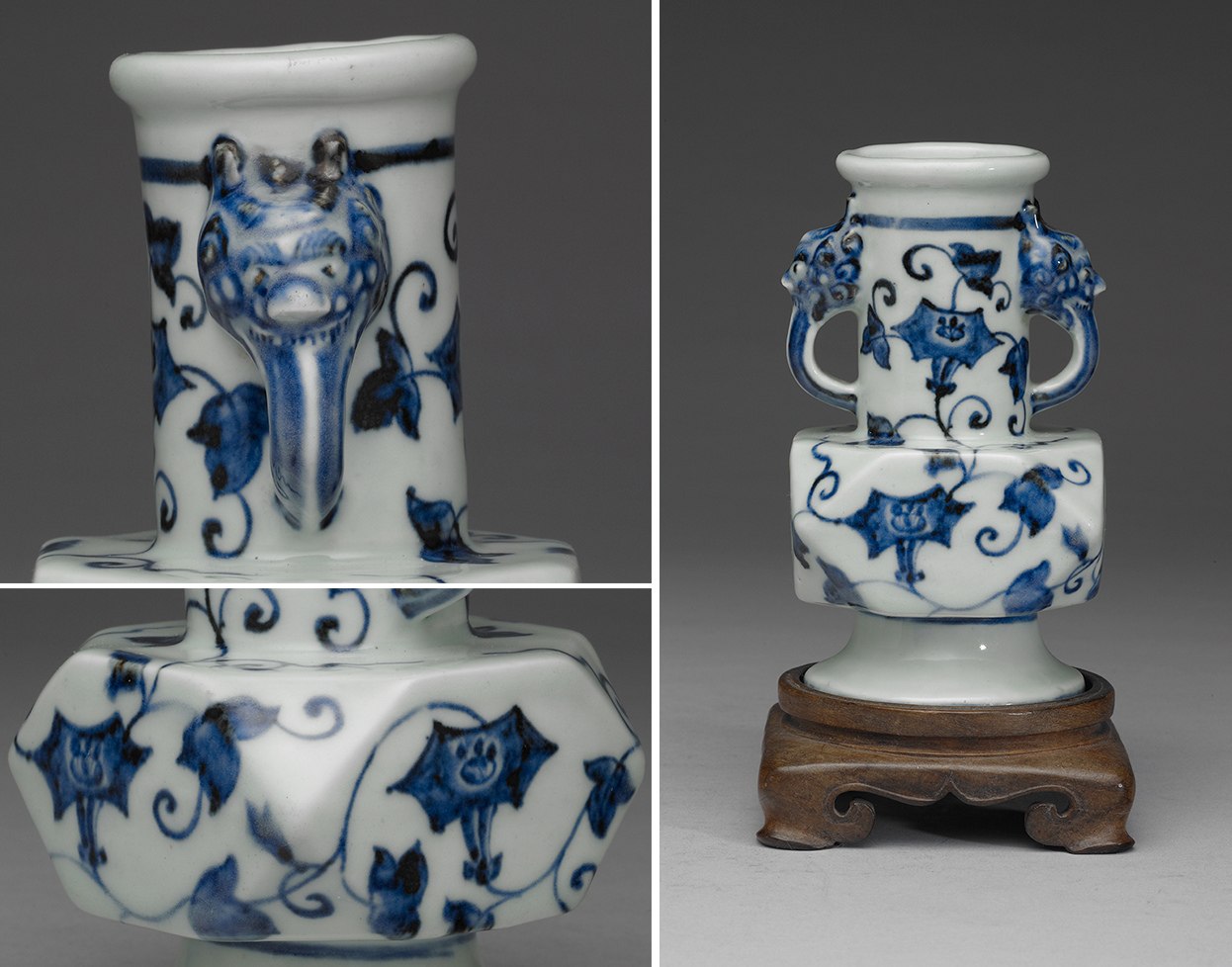
明 宣德 (1426-1435) 青花牽牛花卉紋折方瓶
Faceted vase with morning glory decoration in underglaze blue, Ming dynasty, Xuande reign, 1426-1435
多面體的應用
這件折方瓶,長頸方形腹,且腹部上下八個邊角均斜削45度,呈現出多面造形,十分有趣。頸部兩側飾有龍首雙耳,器頸至腹部以青花畫轉枝牽牛花紋,口沿及足邊各畫弦紋一道。仔細觀察青花鈷料聚積處,可以看到鐵褐色的結晶斑點,這是永樂、宣德時期青花瓷器使用「蘇麻離青」鈷料的一個特色。- This faceted vase has a cube shaped body. The upper and lower edged of each of the four corners slant outward from the cube-shaped body at approximately 45 degrees, producing a multifaceted form. A pair of dragon-shaped handles are positioned either side of the neck. Both the neck and body are decorated with underglaze blue scrolling morning glory, framed by single lines of bow strong design at both the top of the neck and at the edge of the foot. The cobalt blue is thickly applied, heaping and piling into crystalline dots of an iron ocher color at points where the glaze has accumulated.
明 成化 (1465-1487) 鬥彩雞缸杯
Chicken cup in doucai painted enamels, Ming dynasty, Chenghua reign, 1465-1487
釉上與釉下彩的鬥艷
這件小杯外壁彩繪公雞、母雞各攜三隻小雞的場景二幅,並以月季、蘭花兩叢相隔開來。鬥彩瓷器的燒造過程,是先以鈷料在成型的素胎上構圖,施加透明釉後經高溫燒製,再於釉下青花輪廓之中敷染紅、黃、綠等其他彩料,經低溫烘烤而成,是同時具有釉下與釉上兩種彩繪的成品。因為工藝有一定難度,自明代晚期就是極受推崇及矚目的陶瓷作品。您可以看出釉下青花及釉上其他色彩不同的層次感嗎?- The exterior walls of this cup are painted in color, with two scenes each showing a rooster, hen, and three chicks, separated by Chinese rose and an orchid. Among the fragments excavated from the Chenghua official kiln at Zhushan in Jingdezhen, Jiangxi province, China, are semi-finished underglaze-blue chicken cups that had only been glazed with cobalt. By comparing these excavated pieces with those transmitted through collections, we understand the process of firing for contending color porcelain vessels.
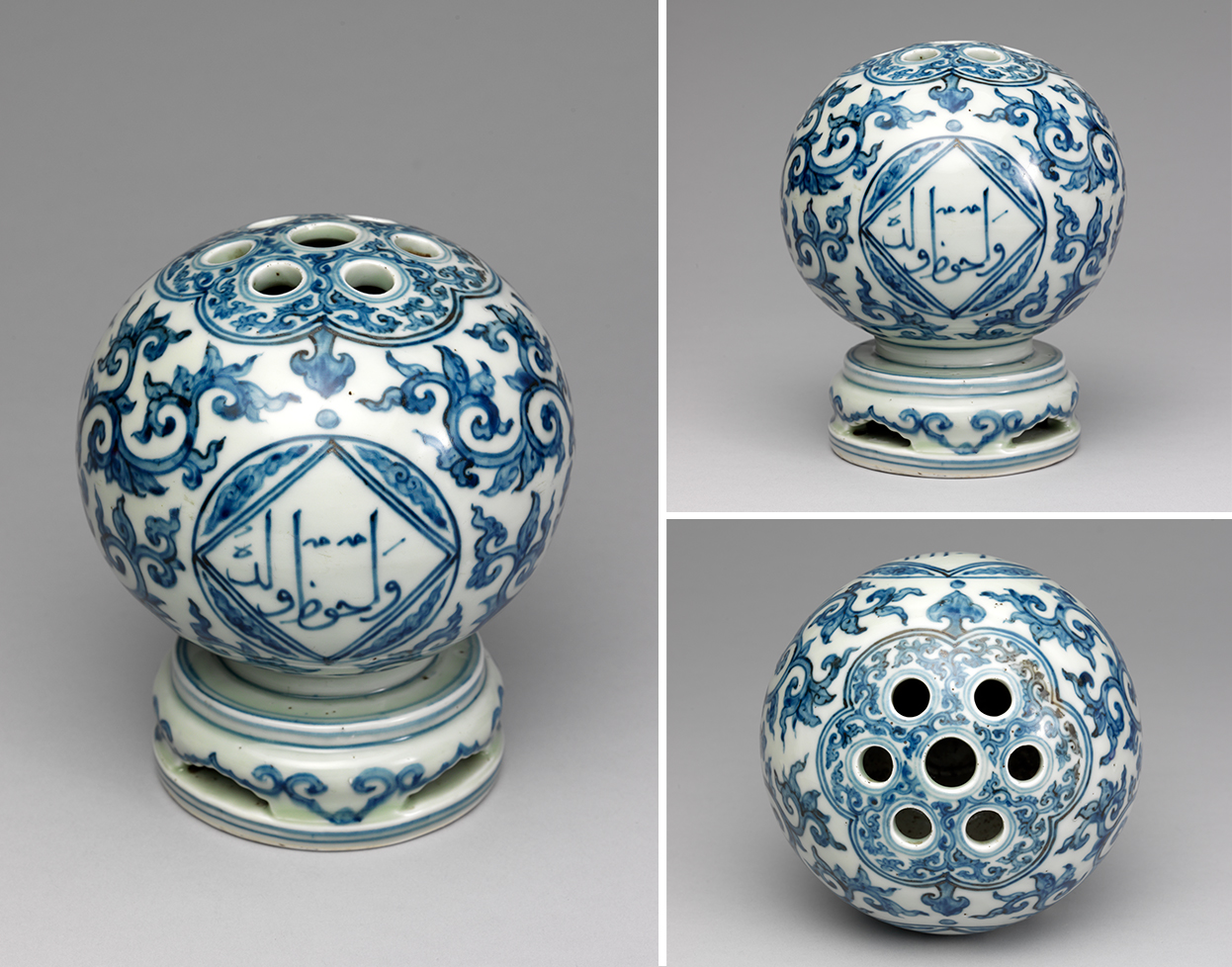
明 正德 (1506-1521) 青花阿拉伯文番蓮紋七孔花插
Globular flower vase with decoration of Arabic script in underglaze blue, Ming dynasty, Zhengde reign, 1506-1521
寫有阿拉伯文的花器
此器由圓球狀主體下連鏤空底座組成,圓球器內中空外壁有兩面開光並飾青花纏枝葉紋,開光內的阿拉伯文祈禱文,可譯為「阿拉會護佑其國土與後裔」,這種書寫阿拉伯文或波斯文的風尚可能跟正德皇帝很熟悉伊斯蘭信仰有關。這件造形如此特殊的青花瓷是一件花器,您猜到了嗎?
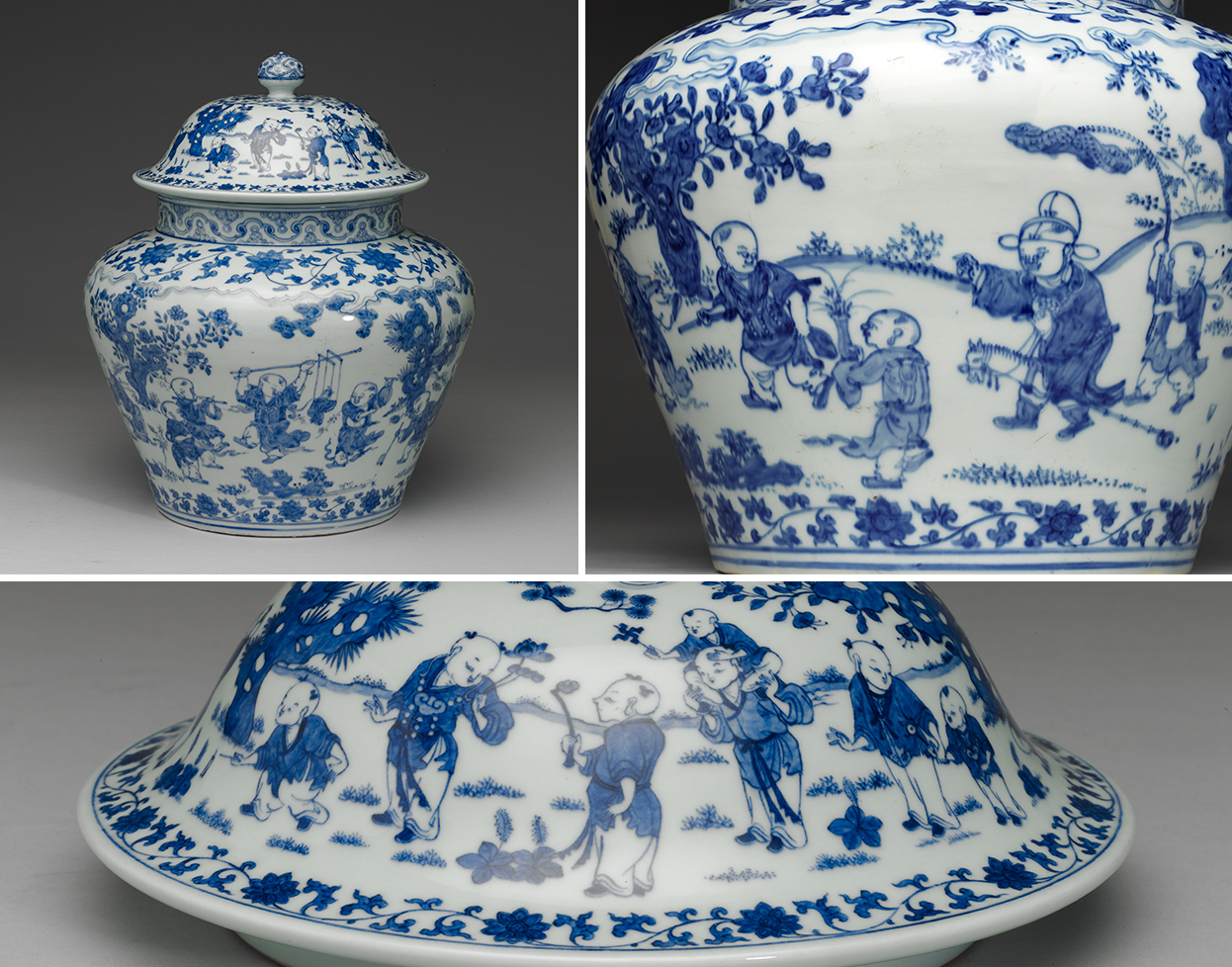
明 嘉靖 (1522-1566) 青花嬰戲圖蓋罐
Lidded jar with children at play in undergalze blue, Ming dynasty, Jiajing reign, 1522-1566
嘉靖朝的童玩百態
這件青花瓷罐胎骨厚重,白釉色澤瑩潤、青花發色鮮艷明亮,展現出嘉靖時期青花瓷器的特色。罐身和蓋頂皆繪童子嬉戲圖,此類嬰戲圖是嘉靖官窯的主要紋飾之一,在盤、碗、高足杯等其它器類上,亦出現相似有趣的圖繪。在各式各樣的童玩中,除了騎木馬之外,其他嬰孩在玩什麼遊戲呢?
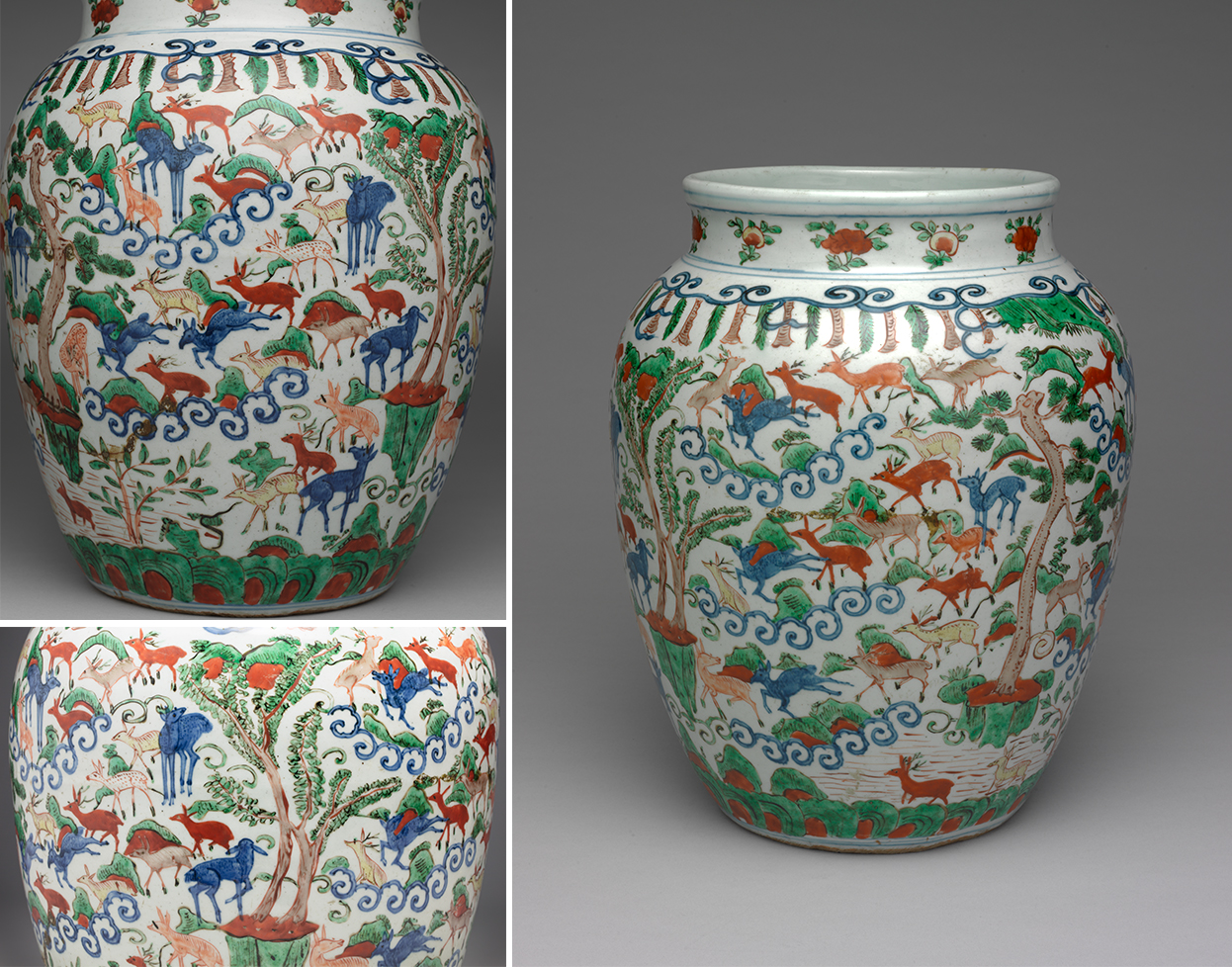
明 萬曆 (1573-1620) 青花五彩百鹿尊
Vase with "One Hundred deer" in wucai painted enamels, Ming dynasty, Wanli reign, 1573-1620
百鹿與百祿
這件百鹿尊,頸部裝飾有折枝朵花及桃實紋。肩部則繪青花雲紋,並垂飾有褐、綠二色相間的飄帶紋。中央主紋於岩石、草叢、林木、雲朵之間,繪滿五彩群鹿八十九頭。近足底處並加飾有或為土地的圖案紋一周,紅綠相映,熱鬧非凡。大家可以感受一下作品上各類色彩紛呈,熱鬧吉祥的氣氛。- The neck of this hundred deer vase is decorated with interspersed designs of floral sprays and peaches. The shoulders are painted with underglaze-blue cloud patterns, from which hang alternating brown and green pennants. A herd of eighty-nine deer in five-color (wucai) glaze amid boulders, foliage, trees and clouds from the predominant motif. Near the foot there is a band of decoration that appears to simulate a ground plane, vibrantly juxtaposing green and red glaze.
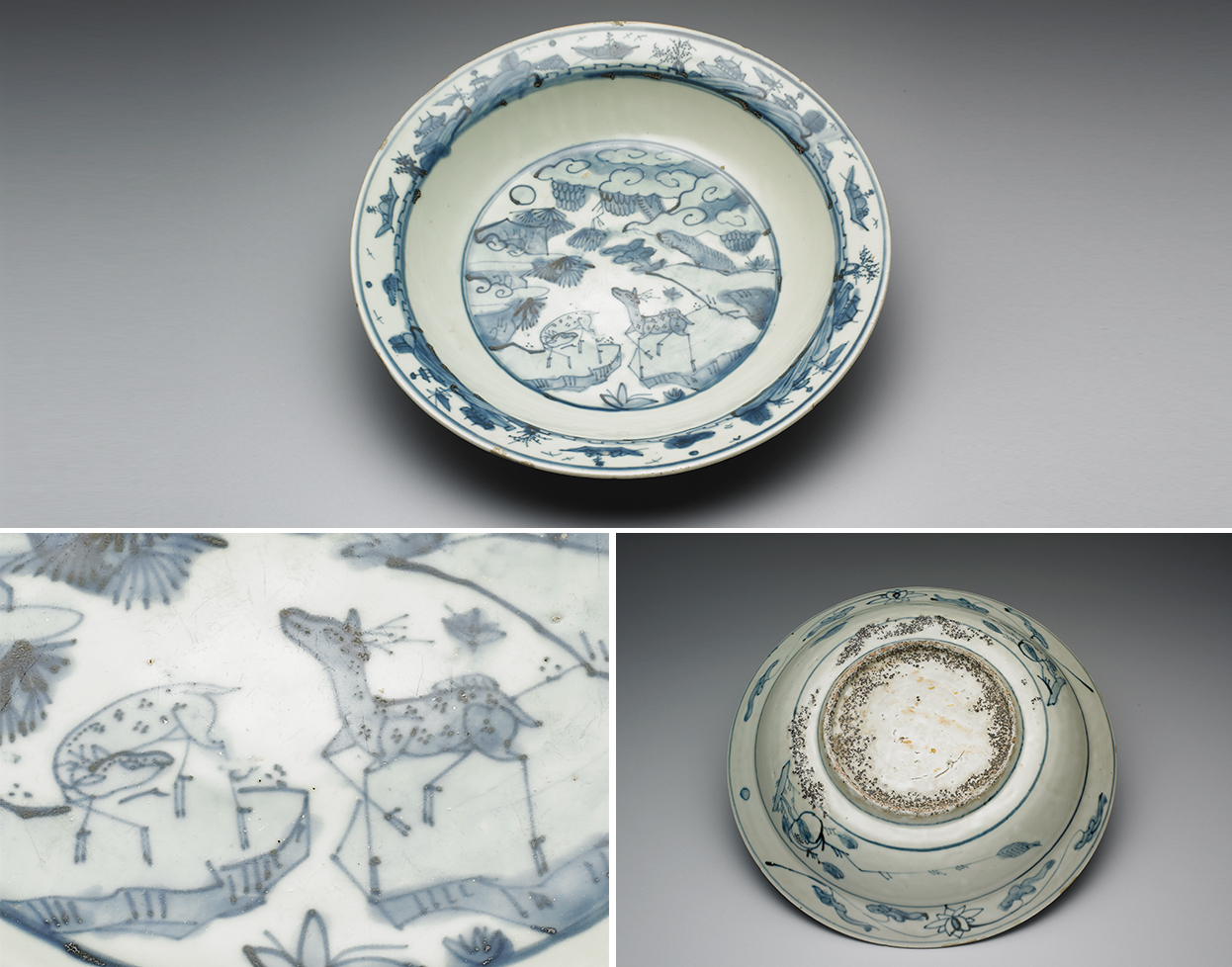
明 十七世紀 青花山水鹿紋盤
Dish with landscape and deer decoration in underglaze blue, 17th century
晚明的外銷瓷器
此類折沿盤的裝飾紋樣和器形,是十七世紀外銷瓷常見的類型之一。底部沾黏墊燒留下的砂粒,依此燒造痕跡及胎釉特徵來看,此件折沿盤應屬福建漳州窯作品。全器紋飾佈局率真寫意,青花設色簡淡,饒富民間趣味。與其他明、清青花瓷器相比,這件作品的青花色澤是不是顯得較為灰暗呢?您可以試著比較不同青花瓷器色彩的差異。
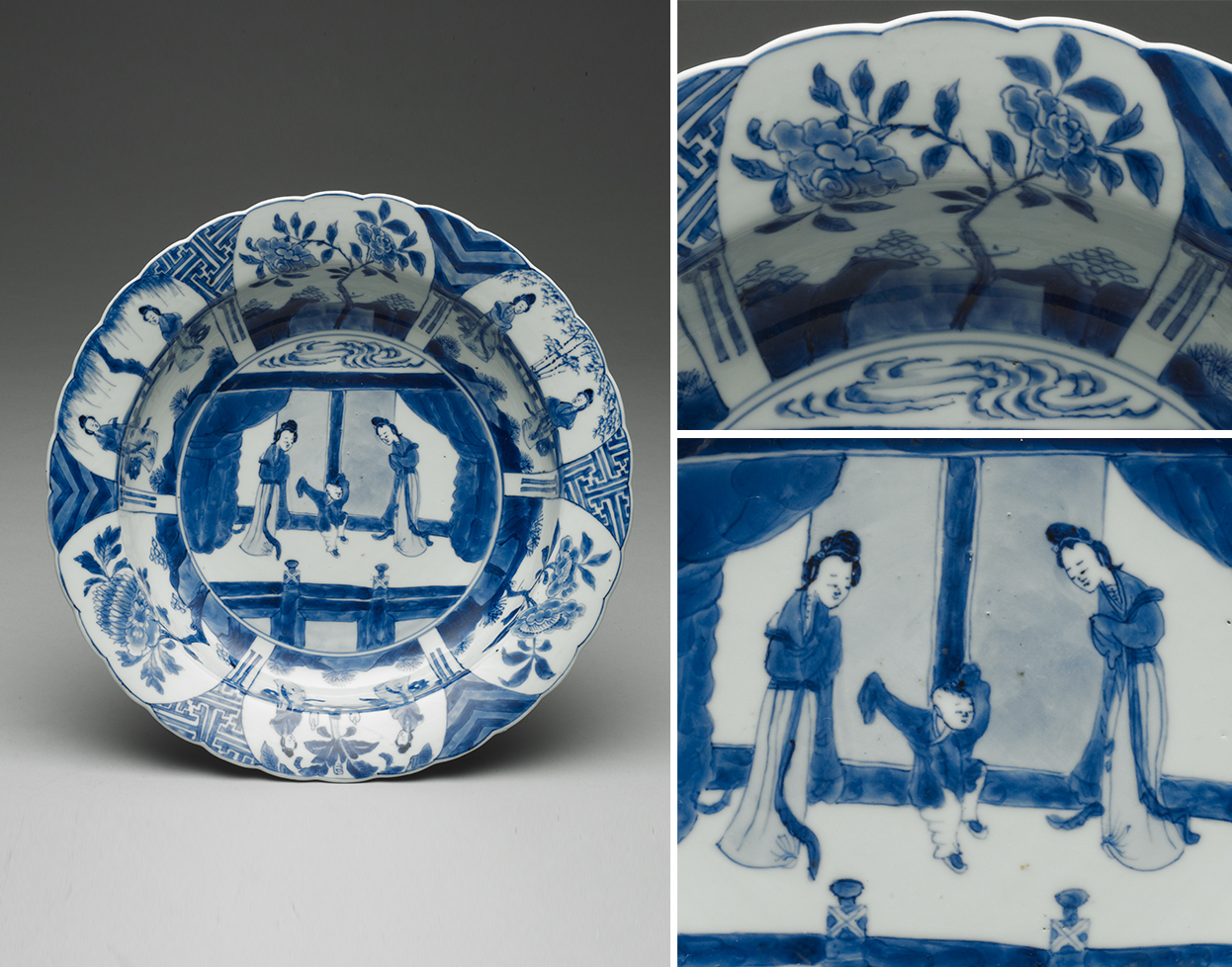
清 康熙 (1662-1722)青花仕女圖花瓣口洗
Washer with ladies in underglaze blue, Qing dynasty, Kangxi reign, 1662-1722
康熙時期的外銷瓷器
這件寬折沿深腹洗,造形是不是很特別呢?因為倒扣之後很像當時流行的絨帽,荷蘭商人以帽子的名稱為這一類瓷器命名。此作品為十七世紀外銷貿易瓷中的一類,反映皇室收藏包含貿易瓷的有趣面向。身軀比例拉長的仕女圖像,也是當時風靡歐洲的「修長伊莉莎白」樣貌。
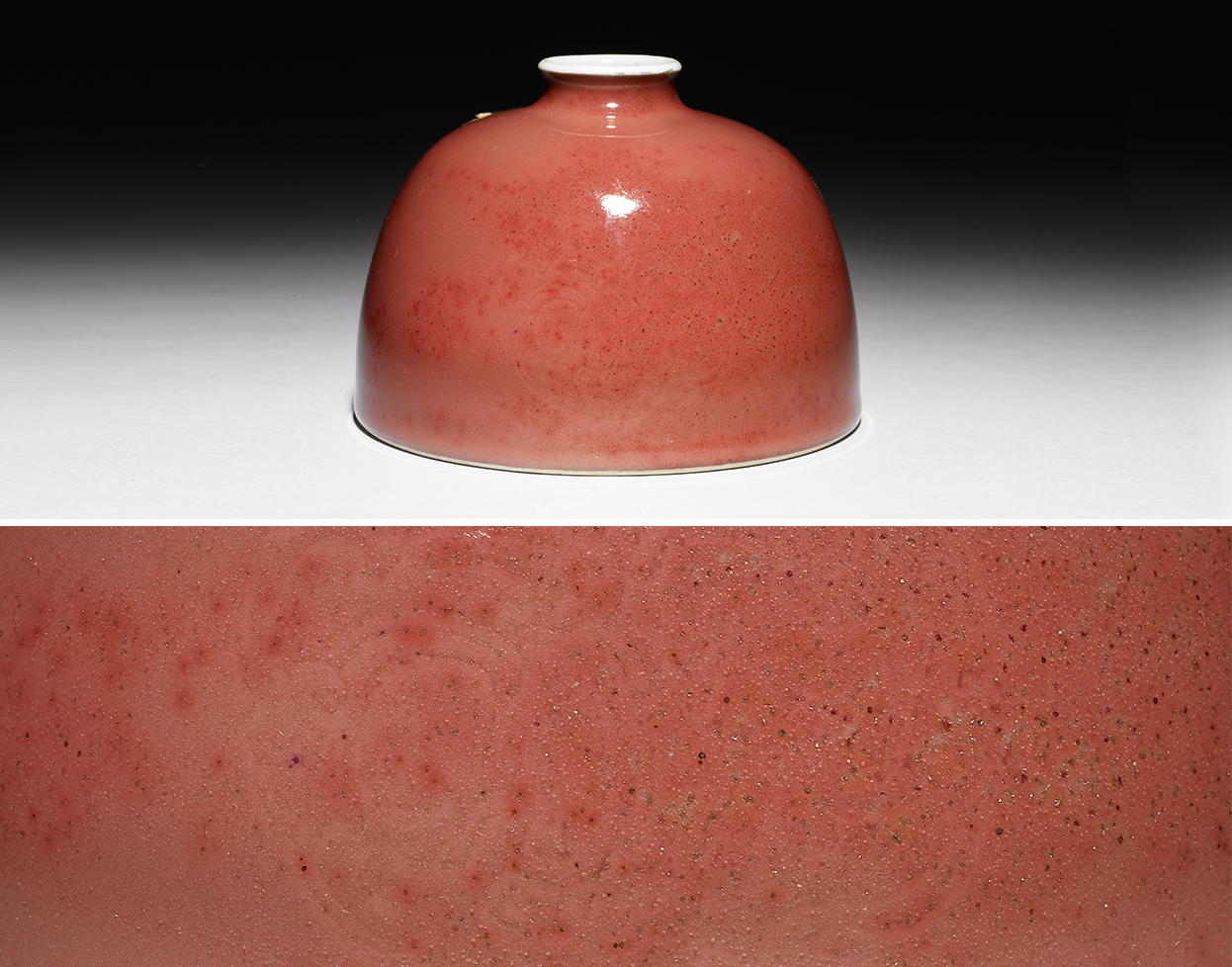
清 康熙 (1662-1722)豇豆紅釉太白尊
Water container with red glaze, Qing dynasty, Kangxi reign, 1662-1722
豇豆般的釉色
這類小口半圓穹狀的器形一般被稱為「太白尊」,是康熙時期官窯典型的器形之一。對照西洋傳教士殷弘緒的書簡,可以知道是以吹釉法施釉。此件太白尊器腹淺劃三組暗花團螭紋,因受窯爐溫度影響,釉色有深淺之別,且揉合紅綠,類似豇(音同姜)豆的色澤。大家可以觀察一下臨近的幾件豇豆紅釉作品,釉色是否各有巧妙不同呢?- This domed hemispherical vessel shape is commonly known as a taibaizun (pure white zun vase). The correspondence of French Jesuit missionary to the Qing court François Xavier d'Entrecolles (1664-1741) tells us that the glaze was blown onto these vessels, a technique known as insufflation (spray glaze). There are three groups of chi dragons have been lightly incised beneath the glaze. The varied dark and light tones in the copper red glaze decorating the body are produced by variations in temperature during firing. The name of this glaze type comes from the color's resemblance to a cowpea.
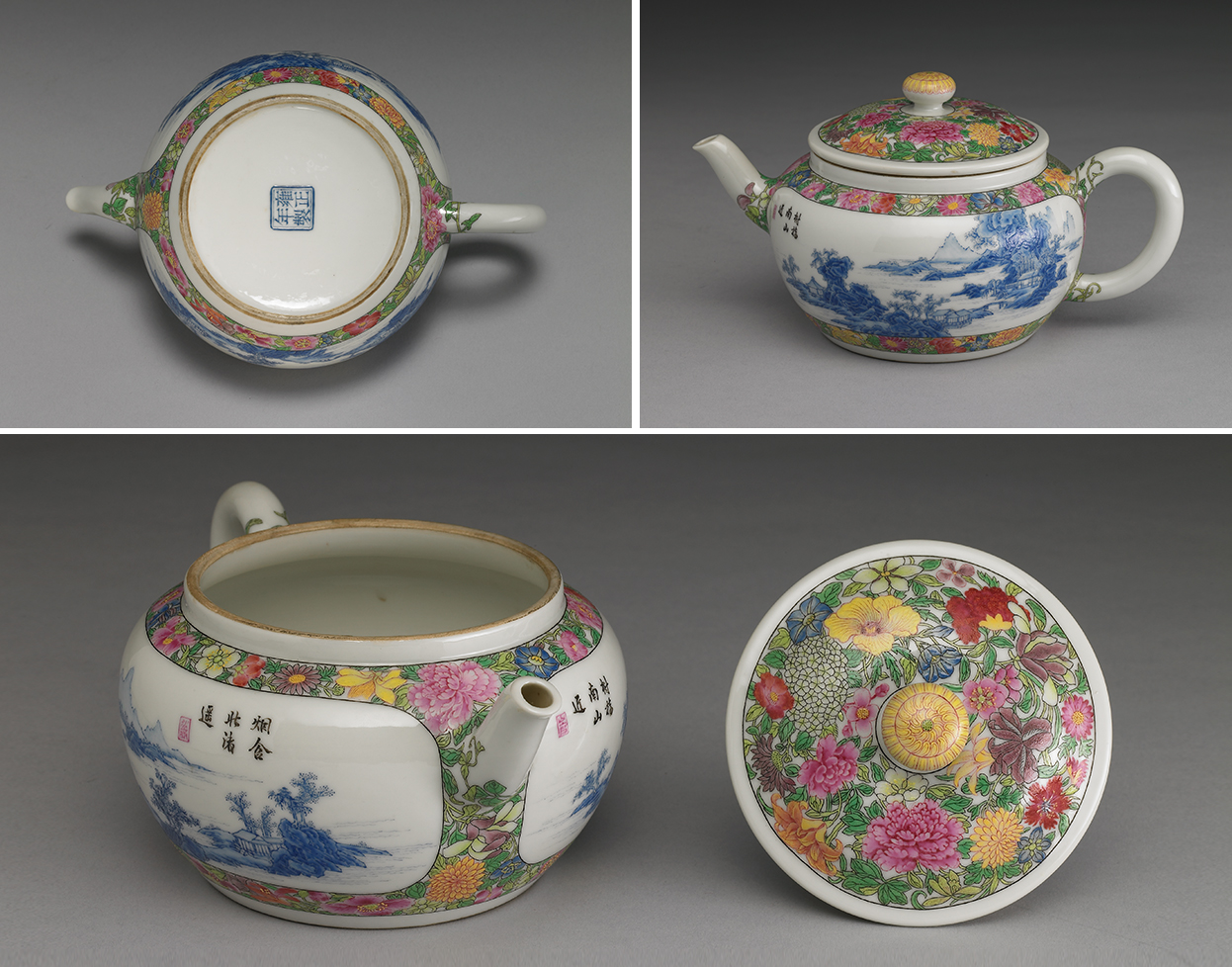
清 雍正 (1723-1735)琺瑯彩青山水壺
Pot with blue landscape in falangcai polychrome enamels, Qing dynasty, Yongzheng reign, 1723-1735
雍正皇帝的茶壺
壺身二側各描繪了一幅山水畫。其中一側,寫有「樹接南山近」詩句,詩後有「山高」一枚紅料印,集合詩、書、畫、印於一體。山水畫外圈、壺蓋滿飾的花團錦簇山水紋,可能就是雍正朝《活計檔》所載:「百花斗方山水」。壺身的山水圖,是以釉上琺瑯彩藍料描繪,與釉下青花不同。兩者雖然都是藍色,您可以試著比較顏色、質感的差異!- Teapot of the Yongzhen Emperor A piece of landscape is drawn on each side of the teapot. On one side, poem "trees connect with mountain Nan nearby" is written, followed by a red seal mark of "mountain high", which shows the combination of poem, calligraphy and painting. The polychrome patterns of flower brocade and landscape surrounding the paintings and its lid might be the "hundred-blossom and landscape pattern" recorded in the Archival documents of Imperial Workshop of the Yongzhen reign.
The landscape on the body is painted in falangcai blue upon the glaze, which is different from the under-glaze blue. Although they are both blue, please try to differentiate the colour and texture.
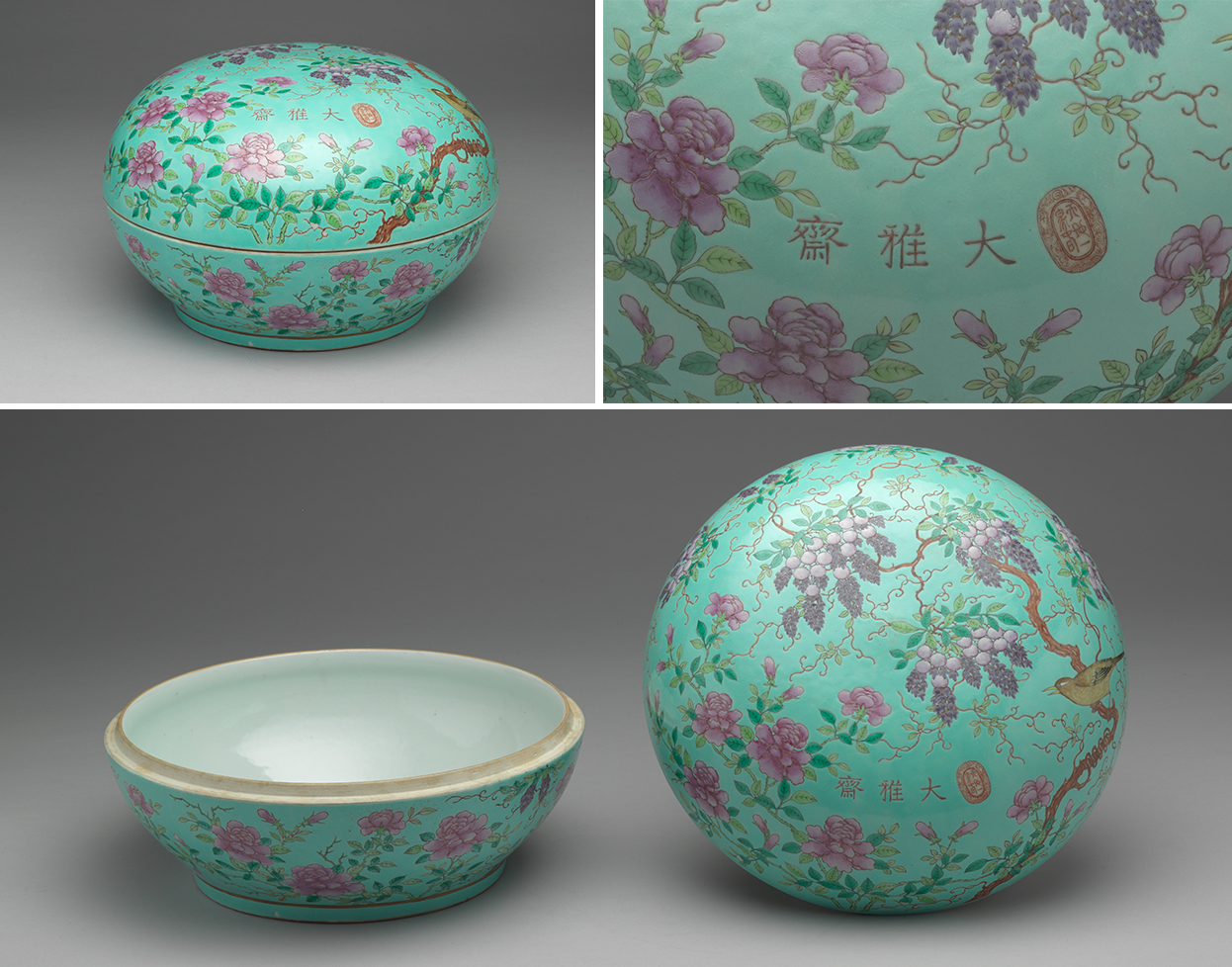
清 光緒(1874-1908)洋彩湖綠地花鳥紋蓋盒
Lidded box with birds and flowers on a lake-green ground and yangcai polychrome enamels, Qing dynasty, Guangxu reign, 1874-1908
慈禧太后的品味
這件蓋盒器外施湖綠色釉,並以粉彩繪石榴、牡丹、鵪鶉組成的花鳥圖,意喻「多子多福,平安富貴」,器蓋上有「大雅齋」款識。清晚期長期掌政的慈禧太后追求文化時尚,引進新畫師,形成一股柔媚婉約的裝飾風格。並以「大雅齋」作為御用瓷器的銘款標記。您能從主體紋飾的選擇和釉色的搭配,感受到慈禧太后獨特的審美品味嗎?- The exteriors of this lidded box are decorated with a lake-green glazed ground, upon which pomegranates, peonies and quails are painted in fencai (famille rose). This bird and flower composition alludes to a blessing for 'many sons, great fortune, peace, wealth and status' (duozi duofu, pingan fugui ). The lid has a script inscription upon it, reading: 'Studio of Great Elegance' (Daya Zhai ). The long dowager empress Cixi (1835-1908) pursued the cultures trends, inviting female painters into the palace who developed a charming and graceful style of decoration. She styled her atelier 'the Studio of Great Elegance' (Daya Zhai ), using the 'Studio of Great Elegance' mark upon porcelains as a designation for imperial use.